
Results 2025?!
What the Results mean?
As the dust settles after results day now is a good time to look at your results and what they mean for you and the year ahead. This post is for year 12 and 10 and I’ll focus on Science but the principles are the same for every modular subject.
So, you had a print-out with grades and a mark. The tendency is to focus on the grade although the mark is equally, if not more, important. The mark given is called a UMS mark and this what will be added together with UMS marks for every module to give you final grade. In year 10 or 12 you are less than halfway through your assessments and so this gives only an indication of where you are. Understanding these, allows you to see what you need in the remaining modules to reach your target and decide whether to re-sit any modules.
The grade boundaries for the UMS scores are always the same and you can find them in the WJEC syllabus under the heading: Grading, Awarding and Reporting. This example comes from GCSE Biology:

In the exam units (1 + 2) you need 108 to achieve a C grade. Unit 3 is the coursework element. The scores of all the units added together will give the final grade as shown below;

This isn’t the whole story since the UMS are converted from the raw mark on the paper. This is done to ensure consistency and that a A grade from one year is equivalent to all the other years. As the papers may have slightly different levels of challenge this can change but you can find how the raw marks for a particular paper have been converted on the following link:
https://services.portal.wjec.co.uk/MarkToUMS/default.aspx
You need to select the correct year, subject, paper and level at the top and the information will appear as below:
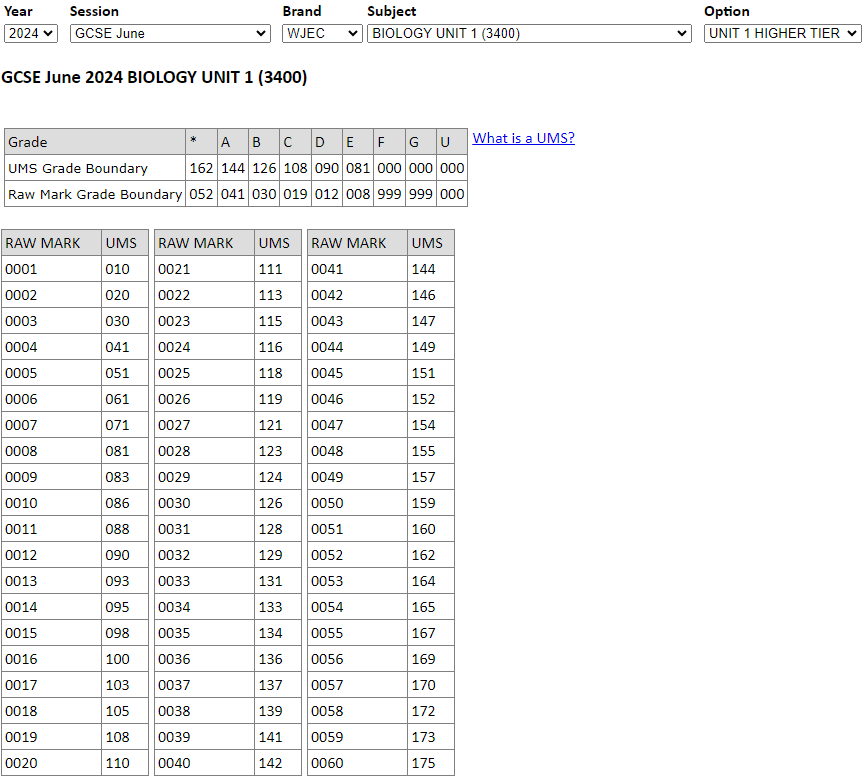
This is this year’s Biology Unit 1 paper, foundation level. The raw mark is out of 80 and from the top table you can see that the boundary for C is 35 out of 80. Since this is a foundation paper the maximum UMS you can reach is 125, and in this paper you’ll need 41 raw marks to reach that.
A few things to bear in mind about re-sitting:
- You can’t “do worse” because even if you score less on your re-sit it’s the best mark that is counted.
- Talk to the school as they know you best and can give individual advice. Schools also have different policies on re-sitting and some may ask you to pay the examination fees.
- If you are a few marks away from a particular grade, achieving that grade next time may not bring you that many extra UMS marks
- It’s not the case of gaining a few extra marks but sitting a whole new paper.
- You need a plan to prepare for a re-sit, check the exam timetable, when would the re-sit be? Before or after your mains exams for the year?
- If you decide to re-sit start setting time aside now to revise the work and practice past paper questions.
- Get in touch if you need help